Best Skyline View Hotels in Greater Buenos Aires
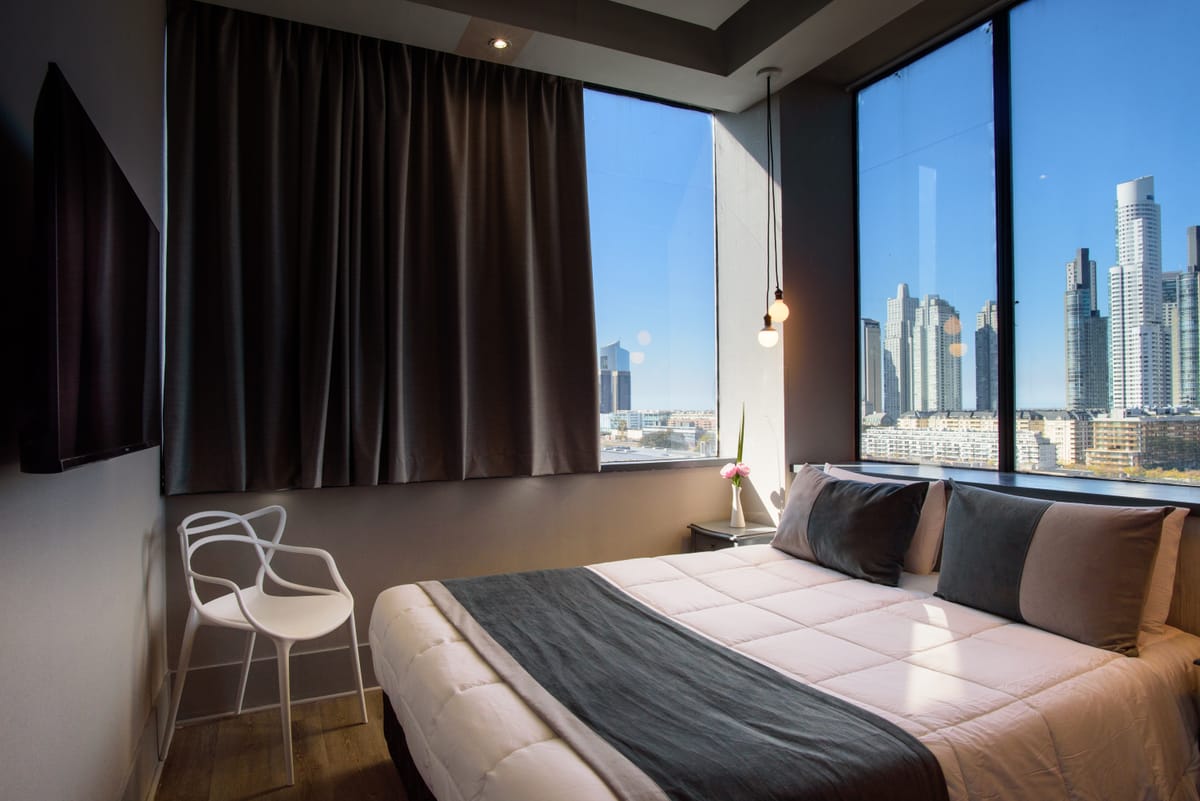
Skyline view hotels in Greater Buenos Aires reward travelers who choose their room for what the window and the roof frame rather than what the lobby promises. The city's most photogenic angle belongs to its eastern edge: around Puerto Madero, restored red-brick docks face the glass of Catalinas Norte and the towers that rose along the old port, with the Puente de la Mujer's white needle in between. A stay here puts that composition on call at all hours, from the first commuter ferries on the Rio de la Plata to the moment the office lights take over from the sky.
Skyline Views · greater-buenos-aires in numbers
Hotels in greater-buenos-aires
What does a skyline actually mean in a city this flat? In Buenos Aires it means contrast: the low, hundred-year-old grid running inland as far as the eye can follow, and the compact cluster of modern towers by the water that breaks it. Rooms and roofs oriented toward that seam get both stories at once, and the evening change of light, masonry going warm, glass going bright, is the show these hotels are built around.
Buenos Aires builds its skyline in one place, which makes choosing a view hotel unusually simple. The towers cluster along the river, from Catalinas Norte and Retiro down through Puerto Madero's residential high-rises, and everything behind them stays low, so a room or rooftop facing that line gets an open composition that few flat cities can match. Morning light comes off the Rio de la Plata and hits the glass first; by late afternoon the sun has crossed the city and the same towers turn to silhouettes against the west. Photographers should note both windows: the river-light hour after dawn, and the blue hour when the Puente de la Mujer's cables catch their floodlights.
A skyline stay in this city is also a neighborhood decision. Puerto Madero's docks hold the boardwalk restaurants and the calm of a district with almost no through traffic, while the blocks just inland put the Microcentro's museums, Casa Rosada and Plaza de Mayo within a fifteen-minute walk. The Reserva Ecologica Costanera Sur closes the eastern side with wetlands and gravel paths where the city noise falls away entirely, an unlikely companion to the towers behind it. Days here alternate naturally between the two scales: mornings in the reserve or the old center at ground level, evenings back up on the roof watching the whole arrangement light up.
The trade-off is worth stating plainly. Puerto Madero and the blocks near it are the city's most polished corner, and they can feel quiet at night compared with Palermo's restaurants or San Telmo's bars; travelers who measure a trip by street life may prefer to visit the skyline rather than sleep beside it. But for a first or last night, an anniversary, or any stay built around the view itself, the eastern edge is unarguable: nowhere else in Buenos Aires puts the river, the bridge and the towers in one frame from your own roof, with the old city's lights spreading flat behind them until the horizon gives out.
Puerto Madero is the city's newest face and knows it: renovated docklands, women's names on every street, joggers on the boardwalks where cranes once worked. Yet the district reads best from above, where its towers stand against the older city's five-story sprawl and the Reserva Ecologica's green flatness runs out toward the invisible far shore. The skyline here is not a wall, it is a single dramatic seam between old grid and new glass.
A traveler's takeI set an alarm for just before sunrise, took the elevator up, and had the roof alone as the light came off the river. The Puente de la Mujer was still lit, Catalinas' glass went from grey to bronze in about ten minutes, and somewhere below a ferry horn marked the first crossing. I was back in bed by seven, already sure the alarm had been the trip's best decision.